
Sold a property? Eight different ways to reduce your capital gains tax bill
New Delhi, Sep 30, 2026
Selling a house, flat or plot can result in a sizeable capital gains tax bill, but the tax is not simply calculated on the difference between what you paid and what you sold the property for.
The Income Tax Act allows taxpayers to account for certain costs connected with the property and, in specified cases, reduce or even eliminate the tax by reinvesting the capital gains.
However, the rules have changed significantly since July 2024. Indexation is no longer the default method for calculating long-term capital gains on property, while a special comparison is available to certain resident individuals and Hindu Undivided Families (HUFs) for properties acquired before July 23, 2024.
Here are the key rules property sellers should know.
1. What expenses can you deduct while calculating capital gains?
There are broadly three important components when calculating the taxable gain on a property sale, as explained by CA Chandni Anandan, Tax Expert at ClearTax:
Cost of acquisition — what you originally paid for the property.
Cost of improvement — qualifying capital expenditure incurred to improve the property.
Expenses incurred wholly and exclusively in connection with the transfer — such as eligible brokerage and certain legal or transfer-related expenses.
The Income Tax Department's capital gains computation framework specifically provides for the cost of acquisition, cost of improvement and expenditure incurred wholly and exclusively in connection with the transfer.
This means routine household expenses should not automatically be treated as a cost of improvement. A taxpayer should retain invoices and supporting documents for major renovation, additions or other expenditure claimed as an improvement cost.
Example: If you bought a property for ₹50 lakh and later incur ₹10 lakh on a qualifying improvement, your cost base before considering other eligible deductions could be ₹60 lakh.
2. How does indexation work under the current rules?
"Indexation is no longer the default. For long-term gains on real estate, a resident individual or HUF who acquired the property on or before 23 July 2024 can choose between two options: 12.5% without indexation, or 20% with indexation, whichever is lower. This choice is available only to that group; non-residents don't get indexation and are taxed at 12.5% without it," said Anandan.
Point to note: The Finance Act, 2024 a introduced a special protection for resident individuals and HUFs selling land or buildings acquired before July 23, 2024.
Why does this matter?
Consider a property bought many years ago. Indexation increases the historical cost for tax purposes to reflect inflation, thereby reducing the taxable gain. A taxpayer who bought the property before July 23, 2024 may therefore need to calculate the tax under both methods before deciding which produces the lower liability.
3. What reinvestment options are available?
Taxpayers with eligible long-term capital gains from property can potentially claim exemptions by reinvesting under provisions such as Sections 54, 54EC and 54F of the Income Tax Act, 1961.
Under the Income-tax Act, 2025, the corresponding provisions are Sections 82, 85 and 86, respectively.
Broadly:
Section 54: Sale of a long-term residential house and reinvestment in another residential house.
Section 54EC: Investment of eligible long-term capital gains in specified bonds.
Section 54F: Sale of a long-term capital asset other than a residential house and reinvestment in a residential house.
The Income Tax Department's current tax-return framework continues to list deductions under Sections 54, 54EC and 54F for relevant capital gains.
The conditions, investment limits and timelines differ, so taxpayers should not assume that all three exemptions work in the same way.
4. When can Section 54 be used?
Section 54 applies when you sell a long-term residential house property and reinvest the eligible capital gain in another residential house, subject to the prescribed conditions.
For example, suppose you sell a residential property and make a long-term capital gain of ₹1 crore.
If you reinvest the eligible ₹1 crore gain in a qualifying residential property within the prescribed period, the entire eligible gain can potentially be exempt.
The exemption is subject to a ₹10 crore cap.
The important point is that Section 54 focuses on the capital gain reinvested, rather than requiring the taxpayer to reinvest the entire sale proceeds.
That distinction becomes particularly important when comparing Section 54 with Section 54F.
5. What if you cannot reinvest immediately?
This is where the Capital Gains Account Scheme (CGAS) can become useful.
"You can park the unutilised gain in the Capital Gains Account Scheme (CGAS) before the return due date, which preserves the exemption while you complete the purchase or construction within the allowed time. Note that Section 54EC (bond) investments cannot be routed through CGAS; they must go directly into the specified bonds within six months," said Anandan.
If the taxpayer has not utilised the eligible capital gain before the income-tax return filing deadline, the unutilised amount can generally be deposited in the Capital Gains Account Scheme, subject to the conditions of the relevant exemption.
The money can subsequently be used for the qualifying purchase or construction within the prescribed period.
The Income Tax Department has also clarified how amounts deposited in CGAS before April 1, 2026 will be treated under the transition to the Income-tax Act, 2025. If an amount remains unutilised after the applicable period, the unused portion can become taxable in the year in which the time limit expires.
6. What exactly is a Capital Gains Account Scheme?
CGAS is essentially a mechanism that allows an eligible taxpayer to set aside the unutilised capital gain while completing the qualifying reinvestment within the statutory window.
For example, suppose you sell a house in December but plan to purchase the replacement house several months later. If you cannot complete the qualifying reinvestment before the relevant return-filing deadline, depositing the eligible unutilised amount in the prescribed CGAS account can help preserve the exemption, subject to the applicable conditions.
For Section 54, the broad statutory windows are:
► Purchase: within one year before or two years after the date of transfer.
► Construction: within three years after the date of transfer.
If the amount is not used within the prescribed period, the unused amount can become taxable.
7. What happens if the new house costs less than the capital gain?
"The exemption is given proportionately. The exact proportion differs between the two sections: under Section 54, exemption is based on the amount of the capital gain reinvested, while under Section 54F, it's based on the net sale consideration reinvested, so a partial reinvestment leaves a larger taxable portion under 54F than under 54," said Anandan.
Section 54 vs Section 54F: How the tax can differ
The following illustration is based on the figures in the supplied calculation sheet.
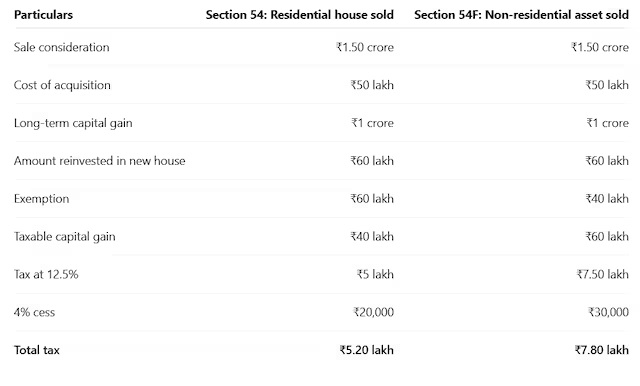
Sale consideration ₹1.5 crore, cost ₹50 lakh, LTCG ₹1 crore, new house ₹60 lakh. Rate 12.5% + 4% cess (FY 2025-26).
What does this show?
The taxpayer has exactly the same sale consideration, cost, capital gain and reinvestment in both cases.
Yet the tax differs by ₹2.60 lakh.
Under Section 54, the ₹60 lakh reinvested is matched against the ₹1 crore capital gain, leaving ₹40 lakh taxable.
Under Section 54F, the calculation is proportionate:
₹1 crore capital gain × ₹60 lakh reinvestment ÷ ₹1.50 crore sale consideration = ₹40 lakh exemption.
That leaves ₹60 lakh taxable, resulting in a tax bill of ₹7.80 lakh including 4% cess, compared with ₹5.20 lakh under Section 54.
The Cleartax example assumes the 12.5% without-indexation method is more favourable and does not apply surcharge. The actual tax outcome can differ depending on the taxpayer's circumstances.
8. Why Section 54F requires extra attention
Section 54F can be important for people selling assets such as land, commercial property or other long-term capital assets and using the proceeds to buy a residential house.
But the reinvestment requirement is stricter than Section 54.
For complete exemption under Section 54F, the taxpayer generally needs to invest the entire net sale consideration in the new residential house, subject to the statutory conditions.
If only part of the consideration is reinvested, only a proportion of the capital gain is exempt.
This is why someone selling a non-residential asset should not assume that buying a new house for an amount equal to the capital gain will automatically eliminate the entire tax.
[The Business Standard]